Jasmine Floral Seamless Pattern: A Refined Black-and-White Design Resource
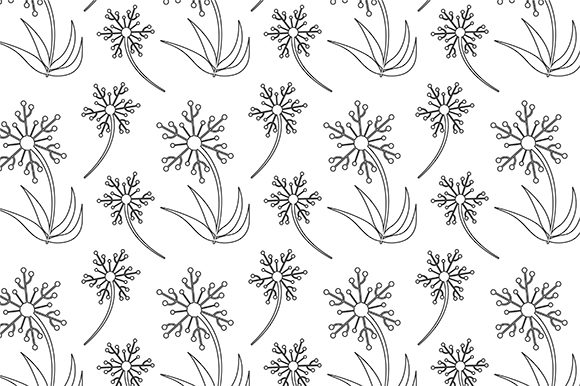
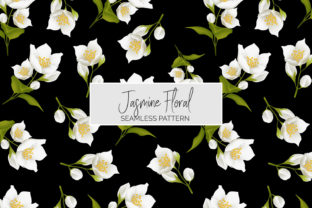
A Jasmine Floral Seamless Pattern is a digitally crafted, tileable design featuring stylized jasmine blossoms arranged to repeat infinitely without visible seams. Unlike photographic or hand-painted floral motifs, this version uses clean vector linework and balanced negative space—rendered exclusively in black and white—to achieve both elegance and versatility. The pattern’s seamless nature means it can scale across any surface—fabric, wallpaper, packaging, or digital interfaces—without distortion or alignment gaps. Its monochromatic palette eliminates color-matching concerns, making it especially useful for print production, embossing, laser cutting, or high-contrast branding applications.
How It Differs from Other Floral Seamless Patterns
Not all floral seamless patterns serve the same purpose—or perform equally across contexts. Many botanical repeats emphasize realism: soft watercolor washes, shaded petals, or layered textures that add visual richness but limit adaptability. Others prioritize density or movement, using swirling vines or overlapping blooms that create rhythm but reduce legibility at small scales. In contrast, the Jasmine Floral Seamless Pattern leans into restraint. Its black-and-white execution removes chromatic distraction, allowing the structural grace of jasmine—its five-petaled symmetry, slender stems, and delicate calyx—to define the rhythm. This makes it function more like a typographic element than a decorative backdrop: legible at 12 pixels on screen or 3 meters on a wall.
Compared to generic “floral” or “botanical” seamless patterns, this design reflects botanical accuracy—not as strict illustration, but as intentional simplification. Jasmine flowers are small, star-shaped, and often clustered; the pattern honors that scale and arrangement rather than exaggerating size or volume for impact. That fidelity supports authenticity in projects where subtlety matters: minimalist stationery, luxury skincare labels, architectural renderings, or editorial layouts seeking quiet sophistication over visual noise.
When Vector Format Adds Real-World Value
The inclusion of an .EPS vector file is not merely a technical detail—it directly affects usability. Vector formats preserve crisp edges at any dimension, which is essential when adapting the Jasmine Floral Seamless Pattern for diverse outputs. For example, a textile designer scaling the pattern to cover a 10-meter-wide curtain needs resolution independence; raster files (like JPGs) would pixelate or require excessive upscaling that degrades line integrity. Similarly, a packaging engineer applying the motif to a die-cut box must retain precise path data for CNC or laser tools—something only vector files reliably provide.
The accompanying 2000×2000 px JPG serves a complementary role: fast previewing, web embedding, mockup integration, or quick client presentations where absolute scalability isn’t required. It offers a consistent, standardized reference point—especially helpful when coordinating with teams unfamiliar with vector workflows. But relying solely on the JPG limits flexibility. If you anticipate resizing beyond standard screen dimensions, printing at large scale, or editing individual elements (e.g., removing stems while keeping blossoms), the .EPS isn’t optional—it’s foundational.
Practical Fit Across Common Use Cases
Designers evaluating the Jasmine Floral Seamless Pattern often ask: “Does this align with my current or upcoming project?” The answer depends less on industry and more on functional and aesthetic priorities.
- Branding & Identity: Works well for brands prioritizing refinement over warmth—think apothecary labels, law firm letterheads, or boutique hotel collateral. Its monochrome clarity ensures consistency across grayscale print runs and accessibility-compliant digital interfaces.
- Textile & Surface Design: Performs reliably on woven fabrics, ceramic decals, or engraved metal. Because jasmine’s form reads clearly even at low thread counts or shallow engraving depths, it avoids the “muddying” common with busier florals.
- Digital UI & Web: Scales cleanly as CSS background patterns or SVG fills. Unlike photorealistic repeats, it imposes minimal bandwidth overhead and remains legible under reduced motion or high-contrast OS settings.
- Architectural & Environmental Graphics: Used effectively on acoustic panels, elevator interiors, or wayfinding signage where pattern repetition supports spatial orientation without overwhelming users.
It’s less suited for contexts demanding emotional warmth, seasonal specificity (e.g., spring marketing campaigns leaning heavily on pastel tones), or cultural symbolism requiring color-coded meaning (e.g., red for luck in East Asian contexts). In those cases, a colored variant—or a different botanical motif altogether—may better fulfill the communication goal.
Tradeoffs to Acknowledge Before Committing
No design resource is universally optimal—and the Jasmine Floral Seamless Pattern has clear tradeoffs worth weighing objectively.
Its strength in neutrality is also its limitation in expressiveness. Without color, it cannot convey mood shifts (e.g., calm blue tones vs. energetic yellows) or support brand color systems directly. Users needing to lock the pattern into a specific hue must recolor it manually—feasible in vector editors but adding time if multiple variants are needed. Likewise, the black-and-white constraint rules out duotone or gradient treatments unless applied externally during production.
Another consideration is scale sensitivity. Because the pattern relies on fine linework and subtle spacing, it can appear sparse or fragile at very small sizes (e.g., 4 mm repeat on business cards) unless adjusted. Some users may prefer a denser floral repeat—or a simplified geometric abstraction—if their application demands high legibility at miniature scale.
Finally, while the pattern is botanically informed, it’s not taxonomically precise. It stylizes jasmine rather than replicates a specific species (e.g., Jasminum officinale vs. Jasminum sambac). That’s appropriate for most design applications—but matters for scientific illustration, botanical education materials, or culturally specific iconography where species-level accuracy carries meaning.
Comparing Alternatives Thoughtfully
If the Jasmine Floral Seamless Pattern doesn’t quite fit, alternatives exist—but they involve meaningful shifts in emphasis. A “generic vine pattern” may offer more flexibility in stem direction or leaf variation but sacrifices floral identity. A “hand-drawn ink floral” brings organic texture but introduces inconsistency in line weight and scalability. A “geometric floral hybrid” (e.g., jasmine shapes rendered as tessellated polygons) gains modernity but loses botanical softness.
Color-based alternatives introduce new variables: managing CMYK vs. RGB conversions, ensuring accessibility contrast ratios, or accommodating substrate limitations (e.g., spot-color printing restrictions). Switching to a colored version of this same pattern solves some expressive needs but reintroduces all the color-related constraints the black-and-white version deliberately avoids.
The decision isn’t about “better” or “worse”—it’s about alignment. Ask: Does the project benefit from timeless neutrality? Is scalability across physical and digital media a priority? Is botanical suggestion sufficient—or is literal representation required? If yes to the first two, and no to the last, the Jasmine Floral Seamless Pattern holds distinct advantages over many alternatives.
Making Your Decision With Confidence
Before downloading or licensing, consider testing the pattern in context. Import the .EPS into your primary design tool and simulate real-world usage: scale it to your intended output size, overlay it on representative substrates (e.g., uncoated paper swatches or fabric scans), and assess contrast against adjacent elements. Preview the JPG in a browser at multiple zoom levels to gauge on-screen readability.
Also reflect on workflow compatibility. Do your team members regularly use vector software? Is your printer set up for vector-based separations? If the answer is uncertain, the JPG provides a safe starting point—but don’t assume it will suffice for final production without verification.
Ultimately, the Jasmine Floral Seamless Pattern excels where clarity, consistency, and quiet intention matter most. It won’t shout—but it will hold space with confidence. For designers who value precision over proliferation, restraint over redundancy, and botanical suggestion over literalism, it remains a quietly powerful choice among available floral resources.