Unicorn Digital Paper: A Versatile Design Asset for Creative Professionals and Everyday Makers
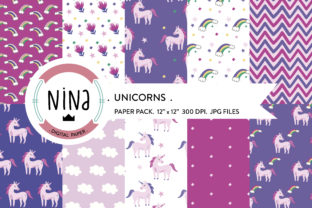
Unicorn Digital Paper isn’t just another themed graphic pack—it’s a thoughtfully crafted, production-ready resource that bridges aesthetic appeal with functional utility across diverse creative workflows. At its core, it consists of 10 high-resolution digital papers—each measuring 12 x 12 inches (3600 x 3600 pixels) at 300 dpi in JPG format—featuring cohesive unicorn motifs layered over vibrant rainbow backgrounds. What distinguishes this collection is not merely its whimsical subject matter, but its intentional design fidelity: consistent color balance, scalable clarity, and intentional negative space that supports text overlay, cutting, and layering without visual clutter.
Why Resolution and Format Matter in Real-World Use
Many free or low-cost digital papers sacrifice technical integrity for speed—offering blurry previews, inconsistent dimensions, or compressed files unsuitable for print. Unicorn Digital Paper avoids these pitfalls by delivering true print-grade assets. The 300 dpi resolution ensures crisp output whether printed on home inkjet printers, professional offset presses, or large-format plotters. Each file’s 3600 x 3600 pixel dimension aligns precisely with standard scrapbooking and cardstock sizing conventions, eliminating guesswork during layout. Unlike PNGs with transparency—which can cause unintended layering issues in certain design software—JPG delivery provides predictable, flattened backgrounds ideal for immediate use in Canva, Adobe Photoshop, Affinity Designer, Cricut Design Space, and even Microsoft PowerPoint.
This technical consistency translates directly into time savings. Educators preparing classroom decorations don’t need to rescale or sharpen images before projecting them onto bulletin boards. Small business owners creating branded gift tags can drop a paper into a template and export print-ready PDFs in under two minutes. Hobbyists assembling memory albums avoid pixelation when zooming into fine details like glitter textures or gradient transitions—details preserved because the originals were rendered at full native resolution, not upscaled from web-sized thumbnails.
Applications Beyond the Obvious: From Functional Tools to Thoughtful Communication
While party invites and scrapbooking are natural starting points, the versatility of Unicorn Digital Paper emerges most clearly in less anticipated contexts. Consider how a single paper functions differently depending on user intent:
- Product packaging prototyping: Entrepreneurs developing children’s toys or eco-friendly stationery use these papers as mockup backgrounds in packaging design tools—testing how product photography interacts with playful yet legible surfaces before committing to physical samples.
- Inclusive classroom materials: Special education teachers integrate the papers into visual schedules or emotion cards, leveraging the high-contrast rainbow palettes to support color recognition while maintaining calming repetition through unified design language.
- Digital wellness resources: Therapists and life coaches adapt the papers as gentle background layers in printable journal prompts or guided reflection sheets—softening clinical tone without sacrificing professionalism.
- Community event branding: Library summer reading programs or neighborhood festivals apply one paper consistently across banners, handouts, and social media graphics, reinforcing thematic continuity without requiring custom illustration budgets.
Each application benefits from the pack’s internal cohesion. Because all 10 papers share the same base palette—muted lavenders, sunlit corals, buttery yellows, and deep indigos—they intermix seamlessly. A card front using Paper #3 pairs naturally with Paper #7 as an envelope liner, while Paper #1’s subtle starburst pattern complements Paper #9’s watercolor wash—all without clashing saturation or competing focal points.
User-Centered Design Decisions Embedded in the Pack
The value of Unicorn Digital Paper extends beyond pixels and DPI. Its structure reflects observable patterns in how people actually work. For instance, the decision to include exactly 10 papers—not 5, not 12—aligns with common project cadences: enough variety to prevent repetition across multi-page documents or rotating displays, yet few enough to avoid decision fatigue during selection. Similarly, the absence of borders, frames, or pre-cut elements respects user autonomy: designers retain full control over cropping, rotation, and tiling—critical for responsive layouts or non-standard formats like hexagonal coasters or circular stickers.
Another nuanced strength lies in texture handling. Rather than relying solely on flat gradients, several papers incorporate micro-textures—faint linen weaves, soft grain overlays, or delicate foil-like shimmer—that remain visible at print size but recede appropriately on screen. This duality supports both tactile expectations (e.g., wrapping paper meant to evoke premium unboxing experiences) and digital accessibility (ensuring contrast remains sufficient for users relying on screen readers or color-blind modes).
Integration Across Skill Levels and Software Ecosystems
One of the most practical advantages of Unicorn Digital Paper is its frictionless compatibility. Beginners using free tools like Google Slides or Canva benefit from drag-and-drop simplicity—the JPG format imports without conversion steps, and the 12 x 12 dimension fits standard slide canvases with room for margins. Intermediate users in Adobe Illustrator appreciate the ability to place files as linked assets, enabling non-destructive resizing and batch updates across multiple artboards. Advanced users leverage the uniform resolution for precise pattern swatch creation or generate seamless repeats using built-in tiling functions—transforming a single paper into infinite wallpaper or fabric designs.
Even offline workflows remain supported. Print-at-home users report success printing directly onto sticker paper, vellum, or kraft cardstock—thanks to the clean color separation and absence of unintended bleed areas. Those scanning finished crafts back into digital archives note minimal moiré or aliasing artifacts, a testament to the original anti-aliased rendering process.
Strategic Considerations for Long-Term Value
When evaluating digital design assets, longevity often outweighs initial novelty. Unicorn Digital Paper demonstrates foresight here: its color palette avoids trend-dependent extremes (no neon fluorescents or hyper-saturated gradients likely to feel dated within months), opting instead for harmonized tones rooted in enduring color theory principles. This allows the papers to age gracefully—remaining relevant for birthday invitations in 2024 and graduation announcements in 2027.
Licensing clarity further enhances utility. As a royalty-free digital product, it permits commercial use—including resale of physical items made with the papers (e.g., handmade greeting cards sold on Etsy)—without requiring attribution or recurring fees. This removes administrative overhead for micro-businesses and sole proprietors who need predictable, scalable resources without legal ambiguity.
Equally important is adaptability to evolving platforms. As more creators adopt AI-assisted design tools, the clean, high-fidelity source files serve as reliable training inputs or style references—feeding consistent visual direction into generative prompts without introducing noise from low-res sources or inconsistent lighting.
Observations from Real-World Implementation
Across user feedback spanning educators, small studios, and DIY communities, recurring themes emerge—not about what the papers “are,” but how they change workflow rhythms. One graphic designer noted reduced revision cycles when clients approve concepts early, attributing this to the papers’ inherent balance of personality and professionalism. A homeschooling parent described how using the same paper across math worksheets and nature journal covers created subconscious continuity that improved her child’s task engagement. A nonprofit fundraiser observed higher open rates on email campaigns featuring headers built from Paper #5—suggesting that carefully calibrated whimsy can enhance message retention without undermining credibility.
These outcomes aren’t accidental. They stem from deliberate constraints: no typography embedded in the papers (preserving typographic flexibility), no fixed aspect ratios beyond the base 1:1 (allowing easy cropping to 4:5 for Instagram posts or 16:9 for presentations), and no reliance on proprietary effects (ensuring compatibility across operating systems and device generations).
Expanding Utility Through Intentional Limitations
Paradoxically, the pack’s focused scope—10 papers, one theme, consistent specs—amplifies rather than restricts utility. By avoiding over-engineering (e.g., layered PSD files with 20 editable layers), it prioritizes immediacy. Users aren’t tasked with learning new file structures; they’re invited to focus on their core objective—whether that’s comforting a nervous student before a presentation, launching a boutique product line, or documenting a family milestone.
This restraint also encourages thoughtful curation. When limited to 10 options, users engage more deliberately with selection—considering emotional resonance, contextual appropriateness, and functional requirements rather than defaulting to “the first one that looks nice.” That act of discernment, repeated across projects, builds visual literacy and strengthens design intuition over time.
In essence, Unicorn Digital Paper operates less as decoration and more as infrastructure—a quiet, reliable layer beneath creative expression. It doesn’t shout for attention; it supports attention. It doesn’t replace skill; it accelerates execution. And in doing so, it fulfills a deeper need shared across professions and passions: the desire for beautiful, capable tools that disappear into the work—so the work itself takes center stage.