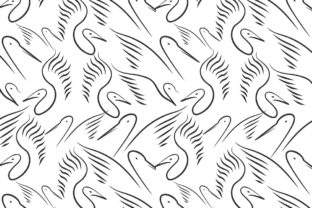
Bird Seamless Pattern Design
Imagine opening a design file and instantly recognizing its versatility — clean lines, organic rhythm, and effortless repetition. That’s the quiet power of a well-crafted Bird Seamless Pattern Design. It’s not just decorative filler; it’s a functional asset. Whether you’re printing fabric for an indie clothing line, building a brand identity for a nature-focused wellness blog, or designing stationery for a boutique wedding planner, this kind of pattern brings warmth, movement, and visual cohesion — without demanding advanced technical skill.
What It Really Is (and What It Isn’t)
A Bird Seamless Pattern Design is a vector-based repeating motif where birds — stylized, realistic, or abstract — interlock across edges so that tiles align perfectly when repeated. The version described here includes a fully scalable vector object, filled with the bucket mesh tool for smooth, editable color gradients. It ships as an EPS file (ideal for print and professional editing), a JPEG (for quick previews or web use), and a help file outlining basic usage — plus a clear license covering personal and commercial applications.
Crucially, this isn’t a raster-only pack of clipped PNGs. It’s not a low-res collection with jagged edges or inconsistent spacing. And it’s not a “seamless” pattern that only *looks* seamless at one zoom level — then reveals misaligned wings or awkward gaps when tiled at actual print size. Those are common oversights people make before they dig in.
Mistake #1: Assuming “Seamless” Means “Ready for Any Use”
Many users download a Bird Seamless Pattern Design expecting plug-and-play results across platforms — only to find it doesn’t tile correctly in Canva, appears pixelated in Cricut Design Space, or fails to scale cleanly in Adobe Illustrator without manual adjustment. Why? Because true seamlessness depends on both the original construction *and* how your software interprets vector paths and bounding boxes.
Better approach: Before importing, open the EPS in Illustrator (or Affinity Designer) and test tiling manually using Object > Pattern > Make. Check corners for stray anchor points or overlapping paths — especially near wingtips or tail feathers — which can break the repeat. If you see tiny white slivers or doubled lines, those are fixable, but they require 5–10 minutes of cleanup, not zero effort.
Mistake #2: Overlooking Color Flexibility in Mesh-Filled Art
The bucket mesh tool gives rich, painterly color transitions — perfect for soft-feather gradients or sunset-hued skies behind flying birds. But that flexibility comes with responsibility. Some users assume colors are locked and non-editable, while others try recoloring the entire mesh like a flat shape and end up with muddy, unpredictable shifts.
Better approach: Use the Mesh Tool (U) or Direct Selection (A) to isolate individual mesh points — say, the tip of a beak or the edge of a wing — and adjust hue or lightness there. Or, use Edit > Edit Colors > Recolor Artwork to shift the full palette while preserving mesh relationships. This keeps depth intact instead of flattening everything into uniform tones.
Why This Matters for Real Projects
- A small-batch textile designer needs accurate color separation for screen printing — unedited mesh fills may not separate cleanly without prep.
- An educator creating classroom posters wants consistent contrast for readability — overly subtle gradients can vanish on projectors or printed handouts.
- A blogger embedding the pattern as a background must ensure JPEG exports retain enough detail at web resolution, without bloating page load time.
Mistake #3: Skipping License & File Format Checks Until It’s Too Late
It’s easy to skim the license file — especially if “commercial use allowed” is visible upfront. But buried details matter: Does the license permit use in logos? In NFTs or physical products sold on Etsy? Is redistribution (even as part of a larger template pack) prohibited? One freelancer learned the hard way when their client requested unlimited resale rights for branded tote bags — rights the standard license didn’t cover.
Likewise, assuming the JPEG is “good enough” for large-format printing leads to blurry banners or fuzzy apparel tags. JPEGs compress detail; EPS preserves vectors at any scale. If your project involves signage, embroidery digitizing, or sublimation printing, start from EPS — not JPEG.
What to Verify Before You Download or Buy
Before committing, ask yourself these practical questions — and check the product details for answers:
- Is the pattern built as a true repeat tile? Look for documentation showing the tile boundary (e.g., artboard size labeled “6×6 inches”) and a preview of at least 2×2 repeats.
- Are anchor points clean and minimal? Excess nodes cause scaling artifacts and slow rendering — especially in cutting machines or web SVG exports.
- Does the help file explain mesh editing basics — not just “how to open”? A good one shows how to add or delete mesh lines, adjust opacity per point, or convert to flat color if needed.
- Is the license clearly written in plain English — not legalese — with real-world examples? Phrases like “use in client work” or “sell physical goods containing this design” should appear verbatim.
Hand-Drawn Charm, Not Hand-Drawn Limitations
The description mentions “hand drawn objects,” and that’s intentional — it signals texture, variation, and human rhythm. But don’t mistake that for imprecision. A strong Bird Seamless Pattern Design balances sketch-like character with technical reliability: feather strokes follow consistent weight, spacing between birds stays even across repeats, and negative space breathes evenly — no overcrowding or awkward isolation.
That balance is why it works across contexts: a watercolor-style bird pattern might feel too soft for a tech startup’s slide deck but ideal for an eco-conscious skincare brand’s packaging. The key is matching *intention* — not just aesthetics — to your project’s voice and function.
A Final Note on Scalability & Long-Term Use
You’ll likely use this Bird Seamless Pattern Design more than once. Maybe first for social media banners, later for fabric swatches, then adapted into a monogram or icon set. Because it’s vector-based and mesh-filled, you’re not locked into one look. You can simplify it for embroidery, extract single birds for icons, or recolor sections for seasonal campaigns — all without losing fidelity.
That longevity only works if you treat the file as a foundation, not a finished asset. Take five minutes to name layers, group related elements, and save a “master edit” version before exporting derivatives. Future-you — juggling three deadlines and a printer error — will appreciate the clarity.